
Drivers & barriers
We find what moves behavior.
The drivers and barriers behind the decision that matters – with the tools of behavioral economics.
Behavioral Strategy
We speed up change and transformation – and make collaboration smoother and more effective.
To do that, we measure what holds people back, test what moves them, and prove what works.

Our thesis
Every consultancy now says that transformation depends on people. The open question is a different one: what exactly does it depend on – in your organization, in this team, in this decision? That is not a matter of opinion. It can be measured.
Drivers & barriers
The drivers and barriers behind the decision that matters – with the tools of behavioral economics.
Evidence
Experiments and observed behavior instead of opinions and assumptions.
Interventions
Interventions that hold up in everyday work, each with a metric you can check them against.
Evidence
Only one in three employees without a leadership role finds their own leadership’s communication on AI clear.
BCG, AI at Work · 2026That is how few leaders report that employees actually adopt change.
Gartner HR Research · 2025That is how many online shopping carts are abandoned – almost one in five because the process is too complicated.
Baymard Institute · 2026Why people come to us
What we do
How we work
Describe the target behavior so precisely that a camera could film it. Then: what drives it, what holds it back?
Check on a small scale what actually changes something.
Findings become interventions: processes, defaults, leadership signals, communication.
Roll out, measure, and keep what the data supports.
Case · Industry
A 20-person transformation team in an industrial group with 25,000 employees. AI was being used – out of sight, never officially. A four-week sprint showed: those who treated AI like a search engine gained nothing. Those who used it as a sparring partner gained a lot – and increasingly so.
All cases (in German)Voices from our workshops
“I was completely surprised by what is possible – and how quickly I can become productive here.”
“It was never theoretical, always practical – and always well grounded.”
“I am now firmly resolved to use this approach every day.”
“I feel like getting started on Monday.”
“Insights from behavioral economics are indispensable for demanding communication projects. In our joint projects, Alexis Johann has shown how behavioral design and choice architecture help organizations reach their goals faster and more effectively.”
Quotes translated from German.
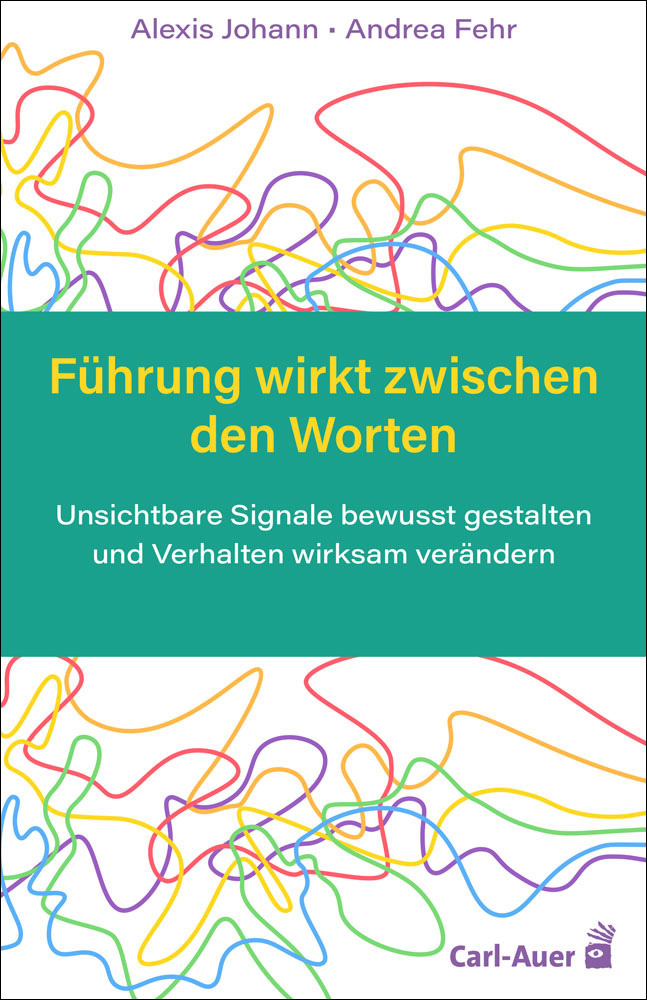
New · Carl-Auer Verlag · October 2026 · in German
Organizations rarely fail because of strategies. They fail because of signals.
The new book by Alexis Johann and Andrea Fehr – the title translates roughly as “Leadership works between the words”. Published in German by Carl-Auer Verlag on October 6, 2026 · EUR 39.00.
Knowledge nuggets
An industrial company started its signal audit not with an analysis but with a question: “What would you tell a new colleague about this organization after three weeks – without using any of the official words?” Officially, people spoke of openness. The answers described a culture of caution.
Try it: ask five people from three levels – and put the answers next to your mission statement.
From “Führung wirkt zwischen den Worten”, p. 145
One simple observation reveals more about a culture than any mission statement: who speaks first, who last, who not at all. Where the official version and the lived experience diverge is where the real diagnosis starts.
Try it: keep a tally in your next meeting – and speak last yourself for once.
From “Führung wirkt zwischen den Worten”, p. 151
A status meeting; a mistake has happened. The leader explains nothing and doesn’t ask for numbers. She waits a moment and asks: “What did you learn from it?” The employee carries on – more freely, more precisely. Others join in. Nobody had to protect themselves.
Try it: after the next mistake, pause for three seconds first. Then ask this one question.
From “Führung wirkt zwischen den Worten”, p. 154
There is one guarding every treasure. Thirty minutes, no obligation.